


A “Simple” Beneficiary Designation Can Undo Your Estate Plan

Why payable-on-death designations often create more problems than they solve
A bank employee asks, “Would you like to add a payable-on-death beneficiary to this account?” It sounds simple, inexpensive, and sensible. Just name a child, and the account will pass directly to that child at death.
But for someone with a properly designed revocable living trust, that seemingly harmless form can bypass the entire estate plan.
We recently encountered the type of problem that can result. A property owner signed a beneficiary designation naming her child. She later developed dementia and could no longer revise her plan. The child then died before she did. When the owner later passed away, the intended transfer no longer worked as expected, and the property became entangled in an avoidable legal and administrative mess.
The lesson is not that every payable-on-death (“POD”) or transfer-on-death (“TOD”) designation is legally defective. The lesson is that beneficiary designations are often poor substitutes for a coordinated trust plan.
A beneficiary form is not an estate plan
A revocable living trust can contain carefully drafted instructions addressing incapacity, successor beneficiaries, minors, vulnerable beneficiaries, creditor protection, taxes, expenses, and unexpected changes in family circumstances. A typical POD form may do little more than identify one person who is to receive one asset.
When an asset passes by POD or TOD designation, it ordinarily passes under the institution’s beneficiary contract—not under the terms of the trust or will. That can produce consequences the client never intended.
1. The beneficiary may die first
What happens if the named beneficiary predeceases the owner? The answer depends on the governing document, the type of asset, applicable law, and whether a valid contingent beneficiary was named. The asset may pass to another named beneficiary, to the beneficiary’s descendants, to the owner’s estate, or under a financial institution’s default rules.
If the owner has dementia or otherwise lacks capacity by then, correcting the designation may be impossible without court involvement—and sometimes impossible altogether.
2. The designation may contradict the trust
The trust may direct that all children receive equal shares, but a POD account may name only one child. It may reflect an old plan, a temporary convenience, or an account opened years before the trust was signed. Nevertheless, the beneficiary designation will generally control that account.
The result may be an accidental disinheritance or a significantly unequal distribution.
3. There may be no meaningful backup plan
A trust can provide a complete chain of contingent beneficiaries. It can state what happens if a child dies before the client, whether that child’s share passes to descendants, and how the share is managed.
A POD form frequently lacks that depth. Even when it permits contingent beneficiaries, people often leave those lines blank or fail to update them after a death, divorce, estrangement, birth, adoption, or remarriage.
4. The beneficiary may be a minor
A minor ordinarily cannot receive or properly manage a substantial account or real property. A court-supervised conservatorship or other proceeding may be required. The child may then gain outright control at the age fixed by law, regardless of whether that is wise.
A trust can instead authorize a chosen trustee to manage the inheritance and distribute it at appropriate ages or under appropriate standards.
5. The beneficiary may have a disability or receive public benefits
An outright POD distribution can disrupt eligibility for means-tested benefits such as Medicaid or Supplemental Security Income. A properly drafted supplemental-needs trust may preserve the inheritance for the beneficiary without requiring an outright distribution.
Naming the individual directly can defeat that protection.
6. The inheritance may be exposed unnecessarily
Once paid outright, the asset may be vulnerable to the beneficiary’s creditors, lawsuits, bankruptcy, divorce, financial exploitation, addiction, or poor financial judgment. A trust can provide continuing management and, when properly structured, meaningful protection.
A POD designation generally cannot.
7. It can undermine planning for a blended family
In a blended family, an outright designation to a surviving spouse may allow the spouse to redirect the property later and unintentionally—or intentionally—disinherit the deceased spouse’s children. A designation directly to children may create the opposite problem by depriving the surviving spouse of resources the estate plan intended to make available.
A coordinated trust can balance both objectives.
8. It can defeat equalization among beneficiaries
Account values change. A client might name one child on a $100,000 account and leave another child a different asset believed to be worth the same amount. Years later, one asset may be worth $400,000 and the other $75,000.
Because the POD asset passes outside the trust, the trustee may have no authority—or sufficient remaining assets—to correct the imbalance.
9. It can deprive the trustee or estate of needed liquidity
Final expenses, taxes, debts, property maintenance, professional fees, and administration costs still must be paid. If the largest liquid accounts pass immediately to individual beneficiaries, the trustee or personal representative may be left with obligations but no cash.
In some circumstances, recovery from nonprobate recipients may be legally possible, but that can require demands, litigation, delay, and expense. It is far better to provide liquidity intentionally.
10. It does not solve probate for everything else
A POD designation avoids probate only for the particular asset covered by a valid designation. It does nothing for an overlooked account, personal property, refund, business interest, lawsuit, mineral interest, later-acquired asset, failed designation, or asset still titled in the owner’s individual name.
Those remaining assets may still force the family into probate. Worse, the most accessible assets may already have been paid to POD beneficiaries, leaving the personal representative to administer an underfunded estate.
11. It can create competing decision-makers and fragmented administration
The trustee may be responsible for carrying out the overall estate plan, while several POD beneficiaries separately control different accounts or properties. No one person has authority to coordinate sales, expenses, tax reporting, property preservation, or distributions.
What was intended as simplification becomes fragmentation.
12. It may create tax and allocation problems
Beneficiary designations can upset carefully planned allocations of estate tax, income tax, generation-skipping transfer tax, charitable gifts, and administrative expenses. Even when no estate tax is due, the plan may need to coordinate basis information, income earned after death, retirement-account rules, and who bears particular expenses.
A beneficiary form is rarely designed to address those issues.
13. Financial institutions may have different forms and default rules
One institution may allow per-stirpes beneficiaries; another may not. One may accept a trust as beneficiary; another may require special wording or additional documentation. Accounts may also be transferred between institutions, merged, retitled, or assigned new account numbers without anyone confirming that the original designation carried forward correctly.
Families often discover the discrepancy only after death, when the owner can no longer explain or correct it.
14. The form may be stale, incomplete, ambiguous, or simply unavailable
Beneficiary forms are frequently completed online or during account opening, then forgotten. Names change. Relationships change. Institutions lose records or retain conflicting versions. A designation may use a nickname, omit a contingent beneficiary, identify the wrong trust, or fail to specify how multiple beneficiaries share.
The apparent shortcut can become the central dispute in the estate.
15. It can increase the risk of undue influence and exploitation
An aging or vulnerable client may be persuaded to change a single account beneficiary without the safeguards and broader review that usually accompany an estate-plan amendment. The change may quietly redirect a major portion of the estate while leaving the formal trust untouched.
This is particularly dangerous when one child, caregiver, or advisor has disproportionate access to the client.
16. It may trigger family conflict
The child named on the account may insist, correctly or incorrectly, that the money was intended as a personal gift. Other family members may believe the child was named only to help pay bills or divide the funds. Unless the documentation is exceptionally clear, the designation can invite accusations of favoritism, mistake, incapacity, or undue influence.
Litigation may cost far more than the planning shortcut ever saved.
The better approach: one coordinated plan
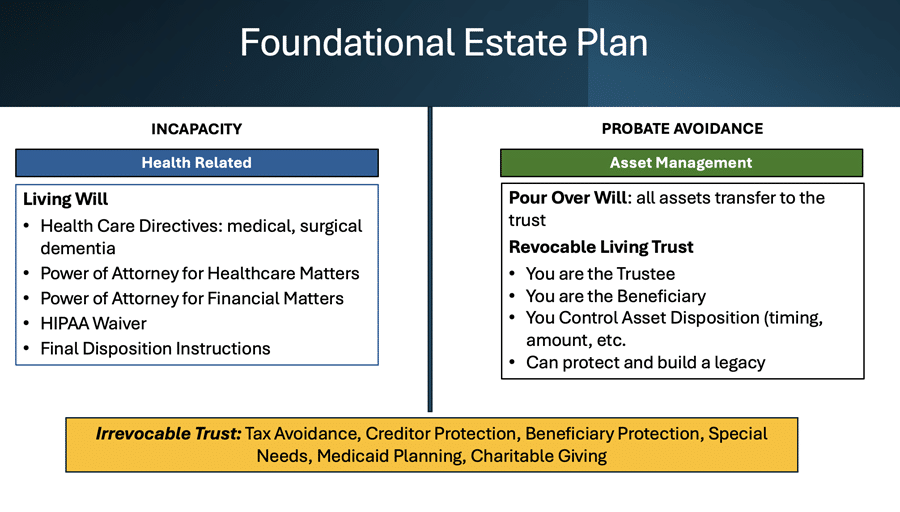
For many clients with revocable living trusts, the cleaner approach is to title appropriate nonretirement assets in the name of the trust and allow the trustee to administer and distribute them under one coordinated set of instructions.
That approach can:
- provide seamless management during incapacity;
- preserve a complete succession plan if a beneficiary dies;
- protect minors and vulnerable beneficiaries;
- coordinate taxes, expenses, debts, and liquidity;
- maintain fairness among beneficiaries;
- reduce the risk of overlooked assets and conflicting instructions; and
- give one fiduciary authority to carry out the plan efficiently.
Are beneficiary designations ever appropriate?
Yes. Retirement accounts, life insurance, annuities, and certain other assets often require beneficiary designations, and tax considerations may make individualized planning essential. In limited circumstances, a POD or TOD designation may also fit a simple and carefully reviewed estate plan.
The key is that no beneficiary designation should be signed in isolation. It should be reviewed as part of the entire estate plan, including the trust, will, powers of attorney, family circumstances, tax considerations, and ownership of every significant asset.
A practical warning
Do not add, remove, or change a POD or TOD beneficiary merely because a banker, broker, title representative, or online form suggests it. Before signing, ask:
Does this designation carry out—or quietly override—my trust?
If you already have POD, TOD, beneficiary-deed, life-insurance, annuity, or retirement-account designations, now is the time to review them. A short coordination review today can prevent probate, litigation, unintended disinheritance, and years of difficulty for your family later.
Schedule a 15-minute discovery call today!
This article is a service of Life & Legacy Law. We don’t just draft documents; we ensure you make informed and empowered decisions about life and death, for yourself and the people you love. That’s why we offer a Life & Legacy Planning™ Session, during which you will get more financially organized than you’ve ever been before and make all the best choices for the people you love.
This material was created for educational and informational purposes only and is not intended as ERISA, tax, legal, or investment advice. If you are seeking legal advice specific to your needs, such advice services must be obtained on your own, separate from this educational material.